


.jpg)
Jan 1, 2027
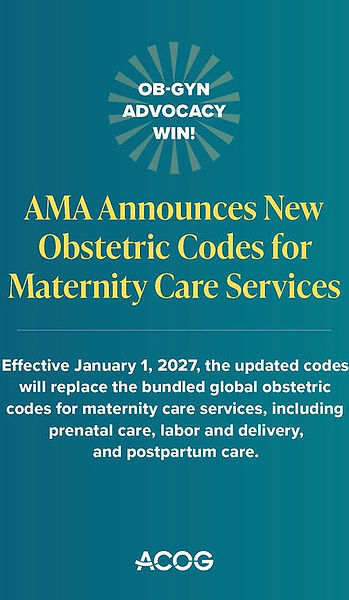
AMA Announces New Obstetric Codes for Maternity Care
Today, the AMA announced the launch of the new obstetric codes, which are set to go into effect for all health plans on January 1, 2027.
This change is the direct result of years of advocacy from our ob-gyn members, who have fought to be able to provide patient-centered care with reduced administrative burden. The deletion of the global obstetric code and transition to new codes is a significant win for our ACOG community and for the sustainability of practice—one that reflects the power of our members’ voices and tireless advocacy.
To support a smooth transition, we’ve developed several educational resources to help prepare ACOG’s ob-gyn members. We’ll also keep creating resources, answering questions, and working with the AMA ahead of January 1, 2027, to make this exciting transition as smooth for our members as possible, so stay tuned for more information and tools in the coming weeks
Apr 18, 2026
First Black woman to win the Pulitzer Prize for Fiction
On this day in 1983, Alice Walker became the first Black woman to win the Pulitzer Prize for Fiction for The Color Purple. A groundbreaking moment that redefined who gets recognized in literature. Its legacy continues to empower generations to reclaim their voices.
.jpg)
Apr 17, 2026
NAACP, Pro-Voter Groups Move to Protect Louisiana Voting Rights
From Louisiana to every corner of the U.S., the NAACP is on the frontlines, fighting to protect the right to vote. 21 million Americans — nearly 1 in 10 voters — don’t have easy access to the documents this law, and those like it, would demand. We should be expanding voting access, not making it harder to vote.
Want to join the fight? Visit http://naacp.org/vote to check your voter registration status and find ways to flex your voting power. https://naacp.org/articles/naacp-pro-voter-groups-move-protect-louisiana-voting-rights
.jpg)
Apr 11, 2026
Black Maternal Health Week
Today marks the start of Black Maternal Health Week. We center the voices and experiences of Black mamas to address the systemic failures that lead to disparate health outcomes. Reproductive justice is a human right.
Black women are often dismissed when reporting pain or symptoms during pregnancy and postpartum. Clinical bias isn't just a hurdle; it’s a life-threatening barrier. We advocate for a healthcare system that believes and respects Black women.
Continuity of care saves lives. Community-based doulas and midwives are essential in providing culturally congruent support and advocacy for Black birthing people. Let's invest in the models of care that work.
As hashtag#BMHW26 ends, our advocacy doesn't. We continue to push for the Black Maternal Health Momnibus Act—comprehensive legislation to end the maternal mortality crisis in America. Policy is the path to progress. hashtag#Momnibus hashtag#HealthEquity hashtag#BMHW26 hashtag#BlackMaternalHealth hashtag#TrustBlackWomen hashtag#BirthEquity hashtag#DoulasMatter hashtag#MidwiferyCare hashtag#TrustBlackWomen hashtag#BirthEquity
.jpg)
Mar 14, 2026
National Council of Negro Women, Inc. HQ
Dr. Camara Phyllis Jones is a Core Four Shero in Healthcare. She draws parallels between racism and health outcomes, showing how systemic inequities shape who gets access to care and who thrives.
.jpg)
Mar 11, 2026
National Council of Negro Women, Inc. HQ
Dr. Patrice A. Harris stands as a Shero in healthcare and a powerful voice for health equity. As the first Black woman to lead the American Medical Association, she turned history into action and used her platform to fight for communities too often left out of the conversation.
.jpg)
Mar 8, 2026
Beyond The Clinic
I had just consented the patient. The anesthesiologist looked around and asked, "Who's the surgeon?"
I'm standing at the bedside. In scrubs. At a hospital I've operated in for almost 10 years.
I just finished consenting the patient. Explained the procedure. Answered questions. Shook hands.
The anesthesiologist looks around the room. "Who's the surgeon?"
I'm right here. Literally right here.
"I am. Dr. Bilbrew."
He pauses. Looks me up and down.
"Geez. I thought you were the family member." Apologetically he scratches his head
Ten years. Same hospital. Same scrubs. Same credentials on the wall. And I'm still being mistaken for a visitor at my own patient's bedside.
I didn't say what I wanted to say.
Didn't ask if he'd ever confused a male surgeon for a family member. Didn't point out that I'd just consented the patient he was about to sedate. Didn't let the sharp thing forming in my throat actually leave my mouth.
Because here's what nobody tells you about moments like this:
The energy it takes to correct them is energy stolen from the patient. The sharpness I swallow is sharpness I can't afford in the OR. The dignity I protect isn't just mine—it's the procedure's.
So I smiled. Confirmed my identity. Moved on.
I didn't carry it into the operating room. I added it to the laundry list.
The list of miscalculations people have made based on my appearance. My gender. My race. My hair. The assumptions that arrive before I do.
I collect them. Not as wounds. As reminders.
Reminders of the position I hold. The power I have to shift paradigms. The responsibility to make sure the next Black woman surgeon doesn't have to answer the same question.
The dignity in that moment isn't the curt response I held back. It's being exactly who I am—calm, competent, undeniable. It's rewriting what "surgeon" looks like in that room.
Ten years. Same scrubs. Still introducing myself.
But every time I do, I'm changing what they expect to see next time.
Beyond The Clinic.
.jpg)
.jpg)
.jpg)
Mar 8, 2026
National Council of Negro Women, Inc. HQ
Honoring Septima Poinsette Clark as one of our Core Four SHEROS for her transformative impact on EDUCATION in her community. She co-founded and directed the Citizenship Schools, training more than 10,000 African Americans in literacy and voter registration and contributing to the registration of over 700,000 Black voters across the South. As Director of Education for the Southern Christian Leadership Conference, she built a network of community teachers and leaders, embedding political education into the Civil Rights Movement and turning classrooms into centers of organized resistance. hashtag#WomensHistoryMonth
Mar 8, 2026
National Council of Negro Women, Inc. HQ
Honoring Gloria Ladson-Billings as one of our Core Four Sheroes in Education. Her work on culturally relevant pedagogy continues to inspire educators to teach in ways that affirm students’ identities and expand what is possible in the classroom. 📚💜
Mar 8, 2026
Maternal mortality dropped 77% in 13 years.
Mar 8, 2026
Maternal mortality dropped 77% in 13 years.
Maternal mortality dropped 77% in 13 years.
No new hospitals. No specialists imported.
Rwanda held an election instead.
-----
In 1994, Rwanda emerged from genocide
with almost no institutions standing.
⭕ No hospitals in most villages.
⭕ No specialists.
⭕ No infrastructure.
⭕ Almost no money.
And a maternal mortality crisis
that demanded an answer.
🔵 So they asked a question:
Who does this mother already trust?
And can we build around that?
The result: community health workers.
Launched 1995.
Not assigned by a ministry.
Not credentialed by a licensing board.
🟢 Elected by neighbors.
🟢 Community members literally lining up
in front of the person they trusted most.
🟢 One maternal health worker per village.
Every pregnant woman, identified.
Every new mother, followed.
By someone who already knew her name.
The intervention wasn't clinical:
It was relational.
✅ Continuity of relationship is an intervention.
✅ Geographic accountability is an intervention.
✅ Removing the mother's burden of navigating the system is an intervention.
All of them required a design decision.
✅ Rwanda's trajectory:
2000: 1,020 per 100,000 live births
2013: 320 per 100,000 live births
2020: 259 per 100,000 live births
Now run that math everywhere else.
🍃 A 77% reduction from 2023 figures:
US: 18.6 → 4.3
Ghana: 234 → 53.8
Nigeria: 1,047 → 241
The US rate for Black women: 50.3
A 77% reduction: 11.6
Lower than the overall US rate today.
When Rwanda's numbers began to plateau, they didn't abandon the model.
They added to it.
Phase 1: design around who is already there.
Phase 2: build specialist capacity on top of that foundation.
Most systems try to start with Phase 2.
Rwanda started with Phase 1.
The foundation held.
The specialists had something to build on.
♻️ What phase is your system in?
Share with someone in maternal care.
If you're working in maternal care,
or have a maternal care story,
this newsletter is for you- real stories from real women:
.jpg)
Mar 25, 2025
Trump cancels NIH grants on equity research
The Trump administration is canceling dozens of National Institutes of Health grants funding health equity research, including work studying Black maternal and fetal health and HIV.
Grantees were told in termination notices delivered over the last several days that their project “no longer effectuates agency priorities” and that “so-called diversity, equity and inclusion (DEI) studies are often used to support unlawful discrimination on the basis of race.”
Advancing health equity was a priority of the Biden administration, creating a tacit acknowledgment that people of color often have worse health outcomes than white people because of racism, increased barriers to accessing health care and other factors.
That fact has been widely been adopted by researchers, health organizations, providers and the medical establishment.
But the Trump administration appears to reject that health disparities exist and that research based on “amorphous equity objectives” are “antithetical to the scientific inquiry, do nothing to expand our knowledge of living systems, provide low returns on investment, and ultimately do not enhance health, lengthen life, or reduce illness,” according to the termination letters.
Read More
Health and Human Services Department spokesman Andrew Nixon defended the cuts — which were listed on the department’s website — saying “HHS is taking action to terminate research funding that is not aligned with NIH and HHS priorities.”
“At HHS, we are dedicated to restoring our agencies to their tradition of upholding gold-standard, evidence-based science. As we begin to Make America Healthy Again, it’s important to prioritize research that directly affects the health of Americans,” he said. “We will leave no stone unturned in identifying the root causes of the chronic disease epidemic as part of our mission to Make America Healthy Again.”
One canceled NIH grant had been awarded to Jaime Slaughter-Acey, an associate professor at the University of North Carolina at Chapel Hill, who was studying studying birth outcomes in Black families.
“This rationale disregards the critical need to address health disparities and the systemic inequities that contribute to the high mortality rates among Black mothers and infants,” Slaughter-Acey wrote on LinkedIn.
That Black woman and babies experience worse health outcomes than their white counterparts is well-known in the medical community, and a concerted effort has been made across the health system to address it in recent years.
“The United States has the highest maternal mortality rate among developed countries and ranks 54th for infant mortality,” said Society for Maternal-Fetal Medicine President Sindhu Srinivas. “Cutting research funding and critical public health programs that support perinatal care only serves to worsen this problem.”
Sen. Bill Cassidy, R-La., the chairman of the Senate Health, Education, Labor and Pensions Committee is among the Republicans who have expressed concerns about maternal health disparities faced by Black women.
The terminations appear in line with President Donald Trump’s executive order titled “Ending Radical and Wasteful Government DEI Programs and Preferencing.”
Other grants being canceled include a project studying autism in girls, several studies related to HIV among Latino and Black men who have sex with men, and a study aiming to reduce health disparities in Black youth with chlamydia.
The NIH also canceled a grant for the Adolescent Medicine Trials Network for HIV Interventions, which aimed to improve prevention and treatment for youth who have HIV or are at risk for it. It was part of dozens of HIV-related grants canceled in recent days.
“Turning our back on HIV research — before we have reached all who need it with HIV treatment or prevention and discovered a cure — will leave us all more vulnerable to HIV and other infectious diseases and have serious consequences for global health security here at home and around the world,” HIV Medicine Association Chair Colleen Kelley said in a statement.
“If the assault on NIH-funded research goes forward, we will see spikes in new HIV infections, a resurgence in deaths from AIDS and tuberculosis and tremendous increases in health care costs.”