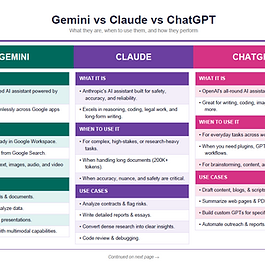
NEWS THAT MATTER
Community Resources
A free-for-all of information to help aid your career, college journey, research, understand concepts, or grow in AI.

No jargon. No gatekeeping. Just the truth.
Health equity, explained without the jargon. Free guide breaking down what health really is, why your zip code shapes your lifespan, and what communities can actually do to change it.
Your zip code shouldn't decide how long you live. A plain-language guide to health equity — built for the people who live it, not the people who study it. 🏥✊🏾
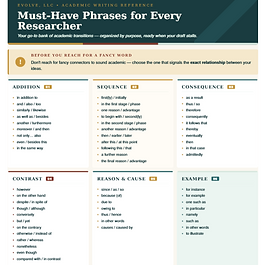
The right word for the relationship you mean.
Stop reaching for "moreover" when you mean "therefore." A free reference grouping every academic transition by what it actually signals — so your draft moves forward instead of stalling.
Every academic transition you need, sorted by the relationship it actually signals — never get stuck mid-paragraph again. 📝🔗🎓

First-gen ready. College-bound.
Turn the college application process into a checklist instead of a crisis. Free month-by-month guide built for first-gen students who don't have a guidance counselor on speed dial — every step, every deadline, every free resource.
The college application system wasn't built for first-gen students. This guide is. Every checklist, every deadline, every free resource in one place. 🎓📝✊🏽

You're your child's most powerful advocate. Here's the law on your side.
Walk into any school meeting knowing exactly what the law guarantees your child. Free fact sheet covering five federal rights, the questions to ask, and who to call when the answer is wrong.
Five federal rights every parent should know before the next IEP meeting, suspension, or "we just can't help with that." 📚⚖️🛡️

Family Wellness Conversation Guide
Open the conversations your kids are quietly waiting for. Free guide with gentle prompts on identity, belonging, school stress, and what thriving really means — built for parents, not therapists.
The questions your kids are hoping you'll ask — and the follow-ups that keep the conversation going. 💬👨👧👦💛


Scientific Writing
A scientific paper is a written report describing original research results. The format of a scientific paper
has been defined by centuries of developing tradition, editorial practice, scientific ethics and the interplay
with printing and publishing services. A scientific paper should have, in proper order, a Title, Abstract,
Introduction, Materials and Methods, Results, and Discussion.

Statistics for the Social Sciences
The second edition of Statistics for Social Sciences prepares students from a wide range of
disciplines to interpret and learn the statistical methods critical to their field of study. By using
the General Linear Model (GLM), the author builds a foundation that enables students to see how
statistical methods are interrelated, enabling them to build on the basic skills. The author makes
statistics relevant to students' varying majors by using fascinating real-life examples from the social
sciences. Students who use this edition will benefit from clear explanations, warnings against
common erroneous beliefs about statistics, and the latest developments in the philosophy, reporting,
and practice of statistics in the social sciences. The textbook is packed with helpful pedagogical
features including learning goals, guided practice, and reflection questions.
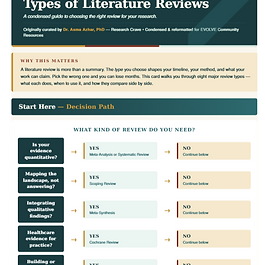
Eight reviews, one decision. Choose wisely.
Pick the right review before you write the wrong one. A free handbook decoding eight literature review types, when to use each, and how to choose without losing six months to a methodology mismatch.
Eight literature review types, one decision flowchart, zero guesswork — the handbook every grad student needs before page one. 📚🧭🎓

Systems Thinking
To understand and appreciate the relationships within systems, several recent projects have adopted systems thinking
to tackle complex health problems and risk factors – in tobacco control, obesity and tuberculosis. On a broader level,
however, systems thinking has huge and untapped potential, first in deciphering the complexity of an entire health system,
and then in applying this understanding to design and evaluate interventions that improve health and health equity.
Systems thinking can provide a way forward for operating more successfully and effectively in complex, real-world settings.
It can open powerful pathways to identifying and resolving health system challenges, and as such is a crucial ingredient
for any health system strengthening effort.

Your Story Matters
Step into research as a partner, not a participant. A free plain-language guide that explains co-researcher rights, the five-step EVOLVE process, and why your lived experience is the evidence.
You're not the subject of the research — you're the expert it's built around. Free guide for families and communities ready to lead the work. ✊🏽📖🌱

Every Claude command, one page, zero guesswork.
Master every Claude slash command, shortcut, and power-prompt on one scannable page. Stop guessing at syntax and start steering the conversation.
Unlock every Claude command and shortcut on a single cheat sheet—built for researchers, students, and curious minds. 🧠⚡📄

So You Want To Help With Research
This guide is yours to keep, write in, return to, and share. It was built for people who have been told that research happens to them — not with them. We are here to change that. This training will give you the knowledge, language, and confidence to participate in research as a full partner. You already have the most important thing: your lived experience.